DiveDex Mobile App (WIP, Working Progress)
A Post-dive Discovery Companion for Recreational Divers
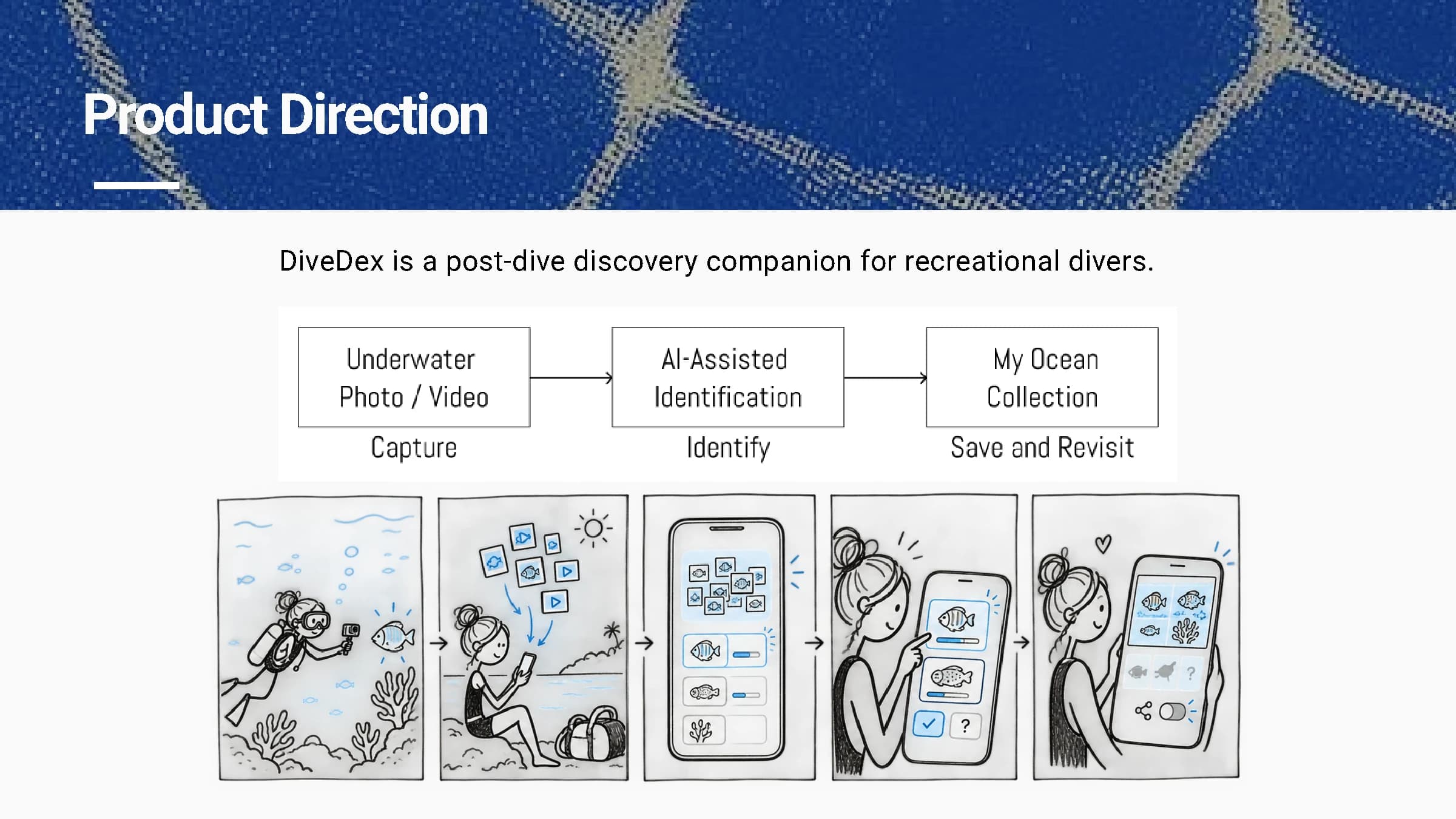
A Post-dive Discovery Companion for Recreational Divers
DiveDex Mobile App is a work-in-progress post-dive discovery companion for recreational divers. It explores how photos and short videos can become a starting point for identifying marine life, learning visible traits and fun facts, and collecting personally meaningful discoveries in My Ocean. The current work covers user research, AI interaction decisions, feature priorities, and low-fidelity wireframes; user testing is still needed.
“What was that fish?”
Underwater discoveries often end in the camera roll. Through 63 survey responses, four interviews, and four secondary sources, I explored the friction between capturing, reviewing, identifying, recording, and contributing. AI supported early exploration and interview hypotheses; the findings come from real surveys and interviews, not AI-generated personas.
Divers already capture underwater encounters in photos and videos. The opportunity begins with the footage they bring back.
Start with existing photos and short videos, without adding tasks underwater.
The survey found that 82% reviewed their media on the same day. Questions about an unfamiliar animal often arise soon after surfacing.
Make it easy to pick up a discovery while the encounter is still fresh.
Similar species and poor footage make identification difficult. A real interview revealed that users may not know enough to notice when AI is wrong.
Flag uncertainty proactively, show short visual cues, and allow unresolved results.
Saved media often remains unorganized. Long, numerous videos make interesting moments difficult to locate.
Help surface relevant moments and connect discoveries to their original media.
The survey and interviews pointed to the effort of organizing discoveries. The interview emphasized a fun, visual collection over a formal logbook.
Build My Ocean around personally meaningful discoveries, with minimal extra work.
Interest in citizen science was much higher than actual participation. Relevant projects, sharing channels, and data use were unclear.
Keep contribution optional and explain the recipient, purpose, and data before sharing.
The interviews challenged the assumption that more evidence and more controls would help. Users needed the system to signal uncertainty and a simple way to question a result. Identification also involved guides, fish books, AI, and social media, with location and habitat helping resolve ambiguity. The desired outcome was a fun, visual “digital aquarium,” rather than a formal logbook.
Updated research slides: the six insights, participant profile, survey findings, interview comparison, and user journey.
The current concept turns photos and short videos into discoveries through AI candidate suggestions, visible traits, and optional location context, then saves them to a personal collection. AI provides a starting point; the diver can confirm, correct, or defer a result. This flow remains in design and preparation for user testing.
Keep species candidates as a useful starting point. Replace dense evidence and excessive controls with short visual cues, uncertainty flags, and simple correction actions. Add optional location and habitat context when images are ambiguous. Avoid false certainty: unresolved outcomes remain valid. Location use is optional, and research contributions require explicit consent with clear information about purpose, recipient, data precision, commercial use, and withdrawal. No automatic sharing is planned.
The must-have scope centers on importing photos or short videos, AI species candidates, visible-trait comparison, confirm/correct/defer actions, a personal discovery record, and the My Ocean collection. Drafts, pending reviews, optional dive details, a private encounter map, and search are next priorities. Regional guides, shareable cards, and opt-in research contributions are potential extensions.
The proposed navigation includes Home, Import & Identify, Explore, and My Ocean. Home brings together drafts, pending AI reviews, and recent discoveries; whether it should remain separate from Import is a question for user testing. Explore is a planned area for regional guides and discovery missions. These low-fidelity screens show a proposed structure, not a finished or validated interface.
Test whether a separate Home helps people resume discoveries, whether the Explore concept is useful, and whether uncertainty cues and simple correction actions are understandable. The findings will guide the next iteration of the navigation and identification flow.